
ISO 14001:2026 - what the new version means for HSE managers and how NV Compliance can support you
The ISO 14001 standard has evolved for the first time in eleven years.
Published on April 15, 2026 by the International Organization for Standardization, ISO 14001:2026 is the fourth edition of the benchmark standard for environmental management systems. It replaces both the 2015 version and its February 2024 climate amendment. The transition period is set at three years: ISO 14001:2015 certifications will remain valid until April 2029.
This is not a revolution: ISO 14001:2026 retains the PDCA (Plan-Do-Check-Act) structure and fundamentals of 2015, but reinforces them on points which, for an HSE or QHSE manager, have very concrete implications.
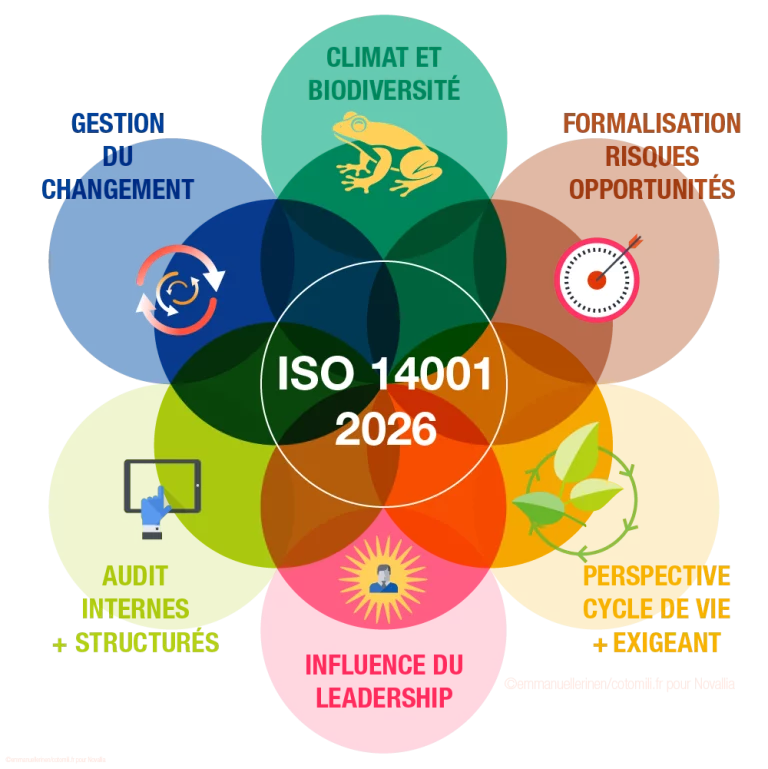
Five key developments!
1. Climate and biodiversity: more precision and explanation * Clause 4.1
The 2015 version already made it possible to integrate climate change as an environmental aspect, but the 2026 version goes further: it explicitly names
- climate change,
- loss of biodiversity,
- pollution and
- availability of natural resources
among the environmental conditions to be analyzed. These topics can no longer be treated as optional. The standard’s official bibliography confirms this orientation, with new references to ISO 17298 (biodiversity) and ISO 14090/14091 (climate adaptation).
2. A new requirement for change management
This is one of the most operational additions to this revision: clause 6.3 is entirely new. From now on, organizations must anticipate and manage internal changes likely to affect the results of their EMS: modification of an industrial process, introduction of a new product, reorganization, change of supplier, merger-acquisition.
The aim is to prevent poorly managed change from creating new non-conformities or degrading environmental performance.
4. Risks AND opportunities: a formalized concept *Article 3.2.10 + Clause 6.1.4
Version 2026 includes the term “risks and opportunities” in the official definitions (article 3.2.10), and devotes a dedicated sub-clause to it (6.1.4). The standard thus invites organizations not only to manage environmental risks, but also to actively identify the potential beneficial effects that the approach may generate: transition to a circular economy, partnerships, proactive adoption of emerging regulations.
5. The life-cycle perspective: more integrated, more demanding
Present in 2015, the life cycle perspective is considerably reinforced in version 2026. It now appears in several places in the standard. In concrete terms, the organization must take into account the environmental impacts of its activities at every phase: design, production, transport, use, end-of-life; and not just during its own operations. This means integrating environmental requirements into purchasing processes and communicating expectations to external suppliers.
6. More structured internal audits *Clause 9.2.2.a
Clause 9.2.2 introduces a new and precise requirement: for each internal audit, the organization must define the objectives, criteria and scope. This is no longer implicit, but documented and enforceable. This is a change that directly affects the audit program and the way organizations justify its design.
ISO 14001: 2026 and regulatory watch. An inseparable link
ISO 14001 – since 2015 and in all subsequent versions – places “compliance obligations” at the heart of the EMS approach. These obligations include not only laws and regulations, but also the organization’s voluntary commitments, contractual requirements or sectoral agreements.
What’s more, when it comes to climate change and biodiversity, which are explicitly mentioned as issues to be assessed, ISO 14001 requires us to keep a constant eye on the regulatory texts that arise from them: the Climate and Resilience Act, environmental reporting obligations, ICPE regulations, European transpositions of directives on biodiversity and water, and so on.
What the standard requires in terms of identifying and accessing compliance obligations (clause 6.1.3) presupposes active, structured and documented monitoring.
And that’s exactly what NV Compliance does: our regulatory and environmental watch and compliance service keeps a constant watch on the legislative landscape in selected areas, with targeted alerts depending on the applicability of texts and your specific obligations.
✅ Companies don’t need to manage a constantly evolving body of regulations on their own: we do it for them, alerting them to what directly concerns them.
Go further: manage your compliance with the standard in NV Compliance
In addition to regulatory monitoring, NV Compliance offers a particularly useful feature in the context of the transition to ISO 14001:2026: the ability to integrate the text of the standard into your compliance databases.
In concrete terms, this means that you can :
- Assess your item-by-item compliance with ISO 14001:2026, using the same tools as for your regulatory obligations;
- Assign responsibility for each standard requirement;
- Monitor your action plans for compliance with version 2026 ;
- Document your evidence and prepare for internal or certification audits;
- Centralize your regulatory AND standards compliance in a single tool.
This integrated approach is also relevant during a transition period: it enables you to map your gaps with the new version, prioritize your efforts and demonstrate your progress to your management or external auditor.
Where to start?
Here are the recommended first steps to ensure a smooth transition from 2026 to 2029:
- Conduct a gap analysis between your current EMS and the new requirements.
- Integrate ISO 14001:2026 into your compliance management tool.
- Check that your regulatory watch covers the broader issues (climate, biodiversity, supply chain).
- Review your lifecycle approach: map your impacts beyond your own operations and formalize your environmental requirements vis-à-vis suppliers.
- Review your internal audit program to integrate the obligation to define objectives, criteria and scope for each audit.
- Make your management aware of the new leadership requirements, which have been extended to all relevant roles.
Would you like to find out more about how Novallia can support you in this transition? Contact our team →