
When we talk about safety culture, we all have in mind examples of major industrial accidents or incidents that have had a major impact on people, the environment and local communities. Safety accidents and incidents are often the result of undesirable safety perceptions and behaviors. Safety culture has been defined by the European Society for Quality in Health Care as a coherent and integrated set of individual and organizational behaviors, based on shared beliefs and values, that continually seeks to reduce harm to employees. In other words, it is important to take a more global look at the organizational culture, the ways of doing things and the ways of thinking of all those involved in prevention. This is particularly true of management and top management.
So how do you prevent and improve safety culture?
In order to prevent accidents and improve the prevention culture, it is not possible to adopt actions that only affect individual behavior. Acting on an organizational culture requires
the commitment of the entire company
. It also requires knowledge of the company’s general level of maturity in terms of prevention: 1. it is important to have a proper assessment of all the risks present within the organization, and this for each work unit; 2. it is then necessary to understand whether all the stakeholders have a shared vision of these risks, and of the means to be put in place to guarantee health and safety within the organization (e.g., “neglected” forms of risk). 3. then, we need to look at the organization’s efforts, the effectiveness of these efforts, and the means put in place by the company to evaluate this effectiveness in terms of safety.
Actions for performance
To then act effectively, improving safety performance requires coherent action on the “3 pillars of safety” (ICSI, 2017):
- Technical dimensions (plant integrity, failure sensors, etc.) ;
- Safety management (formalization of safety processes and procedures) ;
- Recognition of the importance of human and organizational factors (identifying and taking into account the players who influence employee activity, i.e. : – The health and skills of individuals – The quality of communication and exchanges within work groups and teams – The coherence of work situations and tasks to be carried out – The living organization, and the role of managers, employee involvement and participative handling of problem situations, the quality of social dialogue, incident reporting, etc. For example, the appearance of repetitive events linked to psychosocial risks (crying fits, emotional decompensation) should raise significant alarm about the possible impact they may have on the health and safety of the organization (Daniellou et al., 2010).
3 essential steps to identify psychosocial risks
There are three essential steps:
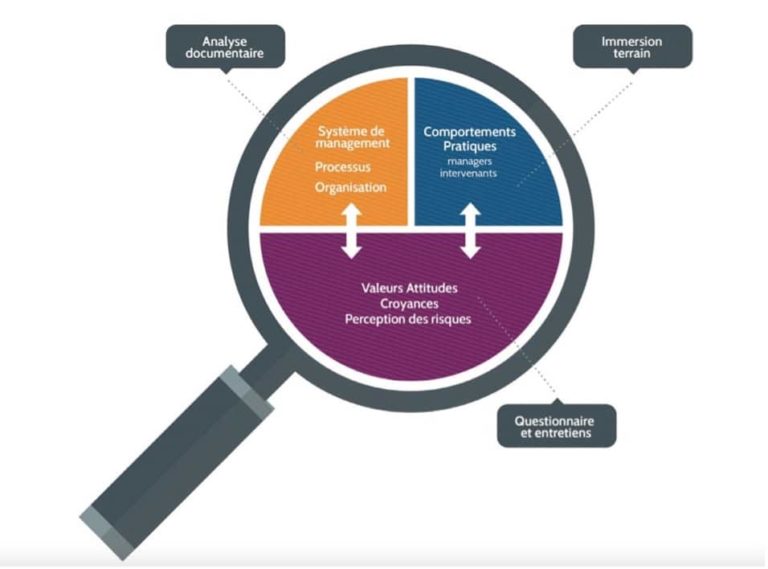
Pre-diagnosis, including :
- Analysis of context and organizational history ;
- Analysis of all available documents (procedures, workplace accidents, management systems, etc.);
Diagnosis of perceptions
of each stakeholder on the impact of the organization and work situations on the safety culture through individual/collective interviews or a questionnaire focusing on employees’ psychosocial perception of occupational health and safety prevention;
Diagnosis through observation of work situations and immersion in the field.
(see image above)
Then come the next steps:
- Communication of diagnostic results and recommendations to project stakeholders
- Acknowledging the diagnosis and defining a shared prevention objective tailored to the company’s needs
- Setting up a global prevention strategy and action plan
- Deployment of actions through all project stakeholders
Beware, however, that any action plan will lead to organizational changes, and we need to anticipate the consequences of this change. Support throughout the process, as well as during the deployment phase, can be an asset in gaining a better perspective on the situation and anticipating the obstacles to implementing the action plan. Safety culture is a fundamental element of organizational culture, and a decisive factor in a company’s performance. How far have you got? Increased absenteeism? Increased number of work-related accidents? Don’t hesitate to contact us for assistance from our experts in health and safety at work.