
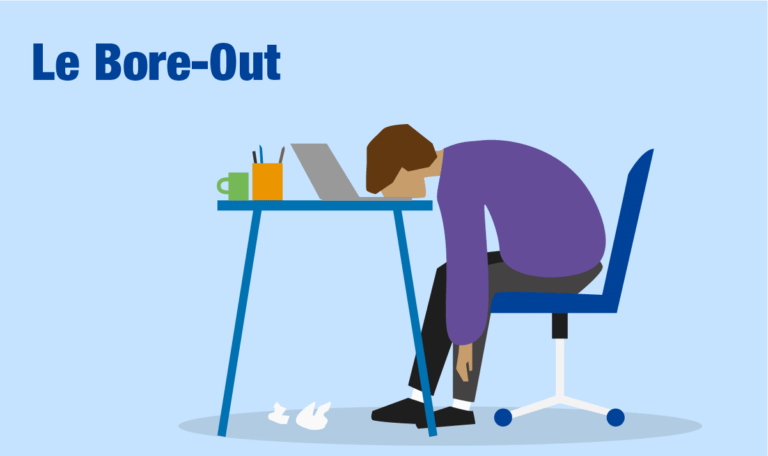
Bore-out? Definition
What’s the link between the pandemic, teleworking and boredom?
One of the consequences of the COVID-19 pandemic has been to change our working habits: telecommuting has become increasingly important in our organizations. While some studies show that most employees have a fairly positive attitude towards teleworking, others point to a significant drop in motivation affecting posture towards one’s work, career, and personal health and well-being. One of the specific effects highlighted as a consequence of telecommuting in epidemic periods is boreout, which is generally associated with the
loss of meaning at work
. Boredom at work is a negative psychological state of diminished desire and satisfaction. When present to a greater extent, these symptoms develop into a state of crisis of meaning and deep boredom with one’s work, as well as a plateauing of satisfaction levels, also known as a “crisis of fulfillment and development”. These symptoms can lead to demotivation and a loss of meaning and purpose in one’s work.
The reasons for this boredom?
In general, lack of work, lack of challenge or stimulation, lack of social contact…
With the pandemic
telecommuting has become increasingly present, even permanent. So-called “protective” factors that could previously serve as professional resources, such as direct social ties with colleagues and superiors, have been drastically reduced. Meaning at work corresponds to a basic need of individuals: to think that what they do is important and has meaning. You can imagine what happens next: lack of meaning leads to stress, anxiety and depression. The repercussions on the company: absenteeism, lower productivity, reduced motivation, inattention, accidents, etc. (read our newsletter on the subject).
Ensuring workers’ health and safety!
For many organizations, teleworking seems to be becoming a long-term work organization. It is therefore important to ensure that employees’ health and safety are not compromised in this highly digitized work organization.
Here are a few ideas to remedy the problem:
- The installation of
efficient IT equipment
is essential to facilitate the digitization of processes. - Recreating
social ties
between employees
through social networks, instant messaging
and others, to avoid feelings of isolation by taking into account and involving all employees. - Offer
online training
with all employees to develop and motivate themselves.
Establish moments of relaxation
between colleagues- Give feedback and recognition to others, as well as to yourself.
- Continue to guide and motivate your teams with objectives.
- Reinstate
social time
with the help of videoconferencing: coffee breaks, lunches, after-work sessions, etc.
These new work situations are not easy to manage, between telecommuting and the constant use of digital tools, with all the risks this entails.
Taking care of these new situations means maintaining the quality and performance of work, and keeping an eye on employee motivation and health.
At Novallia, we offer services to raise awareness, diagnose and implement prevention action plans. If you’d like to find out more, contact our occupational psychologist, SST officer and psychosocial risk prevention specialist!